calling the directory…
netmeeting ils
pinging…
Recently I got an old Acer Aspire TC-780 (Win10), and, as I already got some RPi's, I thought of putting "Raspberry Pi Desktop" on it ( https://www.raspberrypi.com/software/operating-systems/ , at the bottom).
The TC-780 comes with, if I interpret the specs correctly, a combined
HDD+SSD (1TB, 128GB).
I take it I just put the downloaded ISO onto a thumbdrive, plug it into the 'puter, boot from it and than follow the instructions to install the new OS.I've never installed PiOS on a non-Pi device, but yeah I'd expect write
My question is : are there any gotya's I should be aware of ? A specific BIOS configuration perhaps ? Anything else I should be aware of ?
Sounds like a 'hybrid' SSHD device, will just show as a 1TB sata device, with the 128GB acting as a 'hidden' cache.
Sounds like a 'hybrid' SSHD device,
will just show as a 1TB sata device, with the 128GB acting as a 'hidden' cache.
Sounds like a 'hybrid' SSHD device, will just show as a 1TB sata device,
with the 128GB acting as a 'hidden' cache.
Nope, it's a desktop PC with a small SATA SSD for the OS and a regular magnetic HDD for storage.
Hello all,
Recently I got an old Acer Aspire TC-780 (Win10), and, as I already got some RPi's, I thought of putting "Raspberry Pi Desktop" on it ( https://www.raspberrypi.com/software/operating-systems/ , at the bottom).
The TC-780 comes with, if I interpret the specs correctly, a combined HDD+SSD (1TB, 128GB).
I take it I just put the downloaded ISO onto a thumbdrive, plug it into the 'puter, boot from it and than follow the instructions to install the new OS.
My question is : are there any gotya's I should be aware of ? A specific BIOS configuration perhaps ? Anything else I should be aware of ?
Regards,
Rudy Wieser
You could boot into Win10, and use Disk Management
You know how to poke around in there, and figure out the disk layout.
because some older ones are a real liability as storage (the first
generation had some "drop dead" SSDs that caused grief).
If *anything* in that box needs to be replaced, or if an item
was removed by the refurbisher to cheapen the item,
On Fri, 11/20/2026 4:02 AM, R.Wieser wrote:
Hello all,
Recently I got an old Acer Aspire TC-780 (Win10), and, as I already got some >> RPi's, I thought of putting "Raspberry Pi Desktop" on it (
https://www.raspberrypi.com/software/operating-systems/ , at the bottom).
The TC-780 comes with, if I interpret the specs correctly, a combined
HDD+SSD (1TB, 128GB).
I take it I just put the downloaded ISO onto a thumbdrive, plug it into the >> 'puter, boot from it and than follow the instructions to install the new OS. >>
My question is : are there any gotya's I should be aware of ? A specific
BIOS configuration perhaps ? Anything else I should be aware of ?
Regards,
Rudy Wieser
You could boot into Win10, and use Disk Management (right-click Start and
it is in the menu), and you can look at the disk configuration and
orient yourself with respect to what the two devices are doing
right now. Like the 1TB drive could have a single partition saying "Data"
and the 128GB SSD could have a partition that ways "Windows".
You know how to poke around in there, and figure out the disk layout.
Then you can decide, what OS you want to install, and where is the
best place to install it.
Someone may have swapped used storage devices in place of the
original ones. In Win10, I would use something like "CrystalDiskInfo9_5_0.zip"
to check the SMART data on the SSD and determine what percentage of life is left on the drive. It's unlikely to be totally worn out, but you should
be checking the brand and model, because some older ones are a real
liability as storage (the first generation had some "drop dead" SSDs
that caused grief). It took a while for the industry to learn how to
write firmware for SSD drives. Intel staff, when they entered the
SSD business, they took one look at the code the other companies
were using, and they did an eye-roll, the code was so bad.
If *anything* in that box needs to be replaced, or if an item
was removed by the refurbisher to cheapen the item, these days
the replacement cost of just about any item inside that PC,
is going to cost you more than the entire purchase price of the
refurb. Now, more than ever, you're depending on the refurbisher
company to be an honest one.
Paul
Tim,
Sounds like a 'hybrid' SSHD device, will just show as a 1TB sata device, >> with the 128GB acting as a 'hidden' cache.
Nope, it's a desktop PC with a small SATA SSD for the OS and a regular magnetic HDD for storage.
I think Andy is right in regard to the "hybrid SSHD device". Other than
the CD/DVD drive there seems to be only a single other device connected to
a SATA connector. I've also looked if there was perhaps a SSD module on
the motherboard itself, but could not find anything.
I'm not so sure that the SSD part will be a hidden chache though. The BIOS shows them (HDD, SSD) seperatily, so I'm assuming that I (read: Linux) can access them seperatily.
[Snip]I think Andy is right in regard to the "hybrid SSHD device". Other
than the CD/DVD drive there seems to be only a single other device
connected to a SATA connector. I've also looked if there was perhaps
a SSD module on the motherboard itself, but could not find anything.
It's supposed to be at the very front of the mobo - see number 9 here:
I'd install RPi OS on the 128GB drive and then you can mount the HDD
for user data later.
128GB should be plenty for installing apps and other
system stuff.
Theo,
I'd install RPi OS on the 128GB drive and then you can mount the HDD
for user data later.
Inclusive the swap partition ? I assumed that the HDD would be a better place for it.
128GB should be plenty for installing apps and other
system stuff.
:-) As an RPi can run on a 4GB micro-SD I must assume that 128GB is way, way, waaaay more than plenty for it.
If you keep some amount like 10% of the SSD zeroed then the
controller can use those blocks to improve the wear lifetime
('over provisioning').
Theo,
If you keep some amount like 10% of the SSD zeroed then the
controller can use those blocks to improve the wear lifetime
('over provisioning').
Do you mean unpartitioned, or would something special (zeroed?) be needed ?
And thanks for the suggestion.
Regards,
Rudy Wieser
Theo,
If you keep some amount like 10% of the SSD zeroed then the
controller can use those blocks to improve the wear lifetime
('over provisioning').
Do you mean unpartitioned, or would something special (zeroed?) be needed ?
'Empty'. When you delete a file, typically filesystems tell the
device that the blocks are no longer used
If you zero blocks, the SSD can also decide they're 'empty'.
If you leave parts unpartitioned but still containing data from
the last time it was used, the SSD is still contractually obliged
to keep the data in case you need it another time
but also zeroing the SSD and then leaving 10% (or whatever)
unpartitioned works too.
Theo,
'Empty'. When you delete a file, typically filesystems tell the
device that the blocks are no longer used
Ah, you mean I should never fully use the whole partition ("Used
space" vs "Free space"). With 128GB to work with I'm not going to
worry about that. :-)
If you zero blocks, the SSD can also decide they're 'empty'.
I don't understand : when a block is not part of any file chain than its unused. The wear-leveling process could commandeer such blocks at any
time - even though that could twart a later "undelete" attempt.
Paul,
You could boot into Win10, and use Disk Management
I can boot into Win10 alright, but than I'm shown a user-login screen.
Which I can't pass (?). So, no access to Disk Management either (?).
bcdedit /store C:\boot\BCD /set {bootmgr} displaybootmenu True
On Fri, 20 Nov 2026 14:21:29 -0500, Paul wrote:
bcdedit /store C:\boot\BCD /set {bootmgr} displaybootmenu True
Slashes to the left of them! Slashes to the right of them! Foreslash! Backslash! Rah-rah-rah!
On Sat, 11/21/2026 1:22 AM, Lawrence D’Oliveiro wrote:
It's a command line syntax. Just like when we put seven backslashes
On Fri, 20 Nov 2026 14:21:29 -0500, Paul wrote:
bcdedit /store C:\boot\BCD /set {bootmgr} displaybootmenu True
Slashes to the left of them! Slashes to the right of them!
Foreslash! Backslash! Rah-rah-rah!
in some thing we're writing, by "counting all the layers and
dividing by two". It's no different than that. Go to someone elses environment, learn the rules.
The drive doesn't know which (logical) blocks are not part of
a file, unless the OS tells it.
I can boot into Win10 alright, but than I'm shown a user-login screen.
Which I can't pass (?). So, no access to Disk Management either (?).
A technical challenge then :-)
OK, now I see why you're in a paving mood.
One problem is, there were some nice (reasonably easy)
hacks to become Administrator while booting.
Paul,
You could boot into Win10, and use Disk Management
I can boot into Win10 alright, but than I'm shown a user-login screen.
Which I can't pass (?). So, no access to Disk Management either (?).
(in case you are unaware, I'm not a Win10 user. Other than *very* superficially I have no idea how it works)
You know how to poke around in there, and figure out the disk layout.
Thats one of the gotya's I was thinking of : I'm accustomed to Windows installations where I can delete and create partitions as part of the installation process, but I've got no idea if Linux offers the same.
Unless ... there is some gotya there ofcourse. Is there ?Given you don't care about the existing windows installation, I have a suggestion ... stop looking for gotchas, boot it from usb, nuke the disk contents, let PiOS choose its default partitioning scheme on the 128GB
Unless ... there is some gotya there ofcourse. Is there ?
Given you don't care about the existing windows installation, I have a suggestion ... stop looking for gotchas, boot it from usb, nuke the disk contents, let PiOS choose its default partitioning scheme on the 128GB M.2 drive, leave the 1TB drive for later use.
"R.Wieser" wrote:
Unless ... there is some gotya there ofcourse. Is there ?Given you don't care about the existing windows installation, I have a suggestion ... stop looking for gotchas, boot it from usb, nuke the disk contents, let PiOS choose its default partitioning scheme on the 128GB M.2 drive, leave the 1TB drive for later use.
And yes, nuking whats on the drive(s) and and installing Linux is what my initial thought was. I just wanted to make sure that I would not run into any known problems - to anyone in these newsgroups - while attempting to do so.Fairy Nuff.
Mind you, it would be my first time installing this OS as well as doing it
on a 64-bit UEFI 'puter. Don't blame me for being a bit carefull.
"R.Wieser" wrote:
Unless ... there is some gotya there ofcourse. Is there ?Given you don't care about the existing windows installation, I have a suggestion ... stop looking for gotchas, boot it from usb, nuke the disk contents, let PiOS choose its default partitioning scheme on the 128GB
M.2 drive, leave the 1TB drive for later use.
On 21/11/2026 12:15 am, R.Wieser wrote:
Paul,
You could boot into Win10, and use Disk Management
I can boot into Win10 alright, but than I'm shown a user-login screen.
Which I can't pass (?). So, no access to Disk Management either (?).
(in case you are unaware, I'm not a Win10 user. Other than *very*
superficially I have no idea how it works)
You know how to poke around in there, and figure out the disk layout.
Thats one of the gotya's I was thinking of : I'm accustomed to Windows
installations where I can delete and create partitions as part of the
installation process, but I've got no idea if Linux offers the same.
Last time I installed Linux (MGA V6 on my Laptop about 2009) as part of the Installation Process, it offered to Compact and Re-Partition the HardDrive Windows Drives, then I had it set up Partitions for Two Linux OSes, a 'SWAP' Partition and a 'Home' Partition where all my personal files would be stored.
Partition your HD such that you still have 'Work'/User' space spare for your Windows stuff .... then Partition the rest for Linux OS Partition (10-15GB'ish)/Swap Partition(how much RAM do you have?)/Home Partition(The Rest.).
Rudi has no intention of doing anything. This is typical of most of his trolling posts. Ask a question. Respond to each answer with why the
answer is sub-optimal for his specific instance.
A normal person would have just downloaded the ISO to a USB stick
and tried it. But Rudi's trolling as per.
mm0fmf,Here we go again.
Rudi has no intention of doing anything. This is typical of most of his
trolling posts. Ask a question. Respond to each answer with why the
answer is sub-optimal for his specific instance.
Really ? I asked a question which, as to date , *noone* has even acknowledged - even though I made quite clear I wanted to have it answered
(a "none that I know of" would have been enough).
Really ? I asked a question which, as to date , *noone* has evenHere we go again.
acknowledged - even though I made quite clear I wanted to have it
answered
(a "none that I know of" would have been enough).
"*noone* has answered your loaded question in exactly the way you deem to
be correct (not that you would admit it if they did), so you'll keep trolling until everyone else dies of boredom.
mm0fmf,
Rudi has no intention of doing anything. This is typical of most of
his trolling posts. Ask a question. Respond to each answer with
why the answer is sub-optimal for his specific instance.
Really ? I asked a question which, as to date , *noone* has even acknowledged - even though I made quite clear I wanted to have it
answered (a "none that I know of" would have been enough).
The other responses, like what kind of drive I would actually have or
how wear-leveling works or how the drives are partitioned and
formatted under Windows ? Interresting, but in no way anything
that would have any influence to if I would be able to install
Linux.
... or it would fall under the "gotya's" I asked for.
Iow, next time think you see me "rejecting" something, ask yourself
how it is of any consequence to the question I asked. If its not,
than do perhaps realize that its *you* are who is refusing to answer
the question.
A normal person would have just downloaded the ISO to a USB stick
and tried it. But Rudi's trolling as per.
A *normal* person would, before engaging in something new to them,
ask people around them if they have any advice.
You ? You implicitily claim you just ... do something - and than
ofcourse, when something goes wrong, complain about how you could not
have known that. Yeah, duh!
Regards, Rudy Wieser Well, as you seem to have been "reading" this
newsgroup for some time,
On Sat, 11/21/2026 4:32 AM, Daniel70 wrote:
On 21/11/2026 12:15 am, R.Wieser wrote:
Paul,
You could boot into Win10, and use Disk Management
I can boot into Win10 alright, but than I'm shown a user-login
screen. Which I can't pass (?). So, no access to Disk Management
either (?).
(in case you are unaware, I'm not a Win10 user. Other than
*very* superficially I have no idea how it works)
You know how to poke around in there, and figure out the disk
layout.
Thats one of the gotya's I was thinking of : I'm accustomed to
Windows installations where I can delete and create partitions as
part of the installation process, but I've got no idea if Linux
offers the same.
Last time I installed Linux (MGA V6 on my Laptop about 2009) as
part of the Installation Process, it offered to Compact and
Re-Partition the HardDrive Windows Drives, then I had it set up
Partitions for Two Linux OSes, a 'SWAP' Partition and a 'Home'
Partition where all my personal files would be stored.
Partition your HD such that you still have 'Work'/User' space spare
for your Windows stuff .... then Partition the rest for Linux OS
Partition (10-15GB'ish)/Swap Partition(how much RAM do you
have?)/Home Partition(The Rest.).
Rudy is using his Raspberry PI media, so when this is all over, the
machine will look like a Raspberry PI :-)
I have a disc like that, from 2022 or so.
Name: 2022-07-01-raspios-bullseye-i386.iso Size: 3,607,101,440 bytes
(3440 MiB) SHA256: 5FA906DF25E600BF7D7E6A5EB7B0E9B6605E60992EE6C8EFE79BC99E7C2452BD
Paul
Rudi, you MUST have at least half a clue how to install Linux, why not
give it a go??
On 21/11/2026 13:40, R.Wieser wrote:
mm0fmf,
"*noone* has answered your loaded question in exactly the way you deem
to be correct (not that you would admit it if they did), so you'll keep trolling until everyone else dies of boredom.
Just pack it in.
---druck--
And when I than ask for such support its most allways the end of the conversation. Odd, don't you think ?No.
Andy,
Unless ... there is some gotya there ofcourse. Is there ?
Given you don't care about the existing windows installation, I have a
suggestion ... stop looking for gotchas, boot it from usb, nuke the disk
contents, let PiOS choose its default partitioning scheme on the 128GB M.2 >> drive, leave the 1TB drive for later use.
Are you aware of any possible gotya's in your above-described process ?
Nothing about the UEFI possibly being difficult for example ? Nothing about a Linux stub for it that needs to be pre-configured ? Maybe the Linux ISO needs some kind of special handling? Or a reason why I would not be able to boot the Linux ISO from USB on 64bit hardware ?
That is the kind of gotya's I'm asking about.
And yes, nuking whats on the drive(s) and and installing Linux is what my initial thought was. I just wanted to make sure that I would not run into any known problems - to anyone in these newsgroups - while attempting to do so.
Mind you, it would be my first time installing this OS as well as doing it on a 64-bit UEFI 'puter. Don't blame me for being a bit carefull.
Regards,
Rudy Wieser
Daniel70,
Rudi, you MUST have at least half a clue how to install Linux, why not
give it a go??
I think I already answered that question - a few times over even.
Regards,
Rudy Wieser
Can't say I've ever touched a Raspberry Pi. Way back when, I thought I
should have a go as they seemed the ultimate in mobility but,
unfortunately, at that time the Dollars were tight so never got around
to it.
druck,
Really ? I asked a question which, as to date , *noone* has even
acknowledged - even though I made quite clear I wanted to have it
answered
(a "none that I know of" would have been enough).
Here we go again.
"*noone* has answered your loaded question in exactly the way you
deem to be correct (not that you would admit it if they did), so
you'll keep trolling until everyone else dies of boredom.
You're welcome to quote where "noone" did actually answer my question.
I got an old Acer Aspire TC-780 (Win10), and, as I already got some
RPi's, I thought of putting "Raspberry Pi Desktop" on it
You're getting pushback, AFAICT, because you've asked the same
open-ended question four times,
in a thread full of well-meant advice:
Apparently, asking it multiple times doesn't change the answers, instead
it gets people's backs up.
You used to be able to depend on the installer treating UEFI and
Legacy users equally. That is not the case today. When the hardware
presents a "Legacy signature", the stubborn installer tries to
install as UEFI, then it will complain later about "this or that
is missing, oh dearie me".
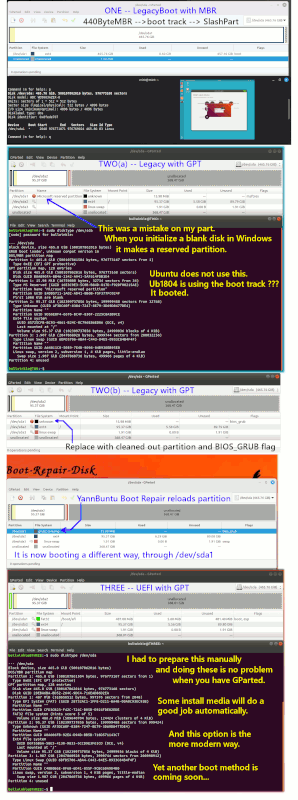
There are at least three install patterns.
Disk partitioning can be MBR or GPT.
Boot can be Legacy (CSM) or UEFI.
Legacy with MBR is straight forward.[snip]
It might be useful for those days, when Secure Boot (as a sub-part
of UEFI) becomes wobbly.
did not appreciate finding a junk partition after a clean of
the disk had been done before hand.
So let's collect some pictures of various boot scenarios.
The Raspbi from four years ago is relatively broken.
You should get a fresh one from Oct 2026 or so,
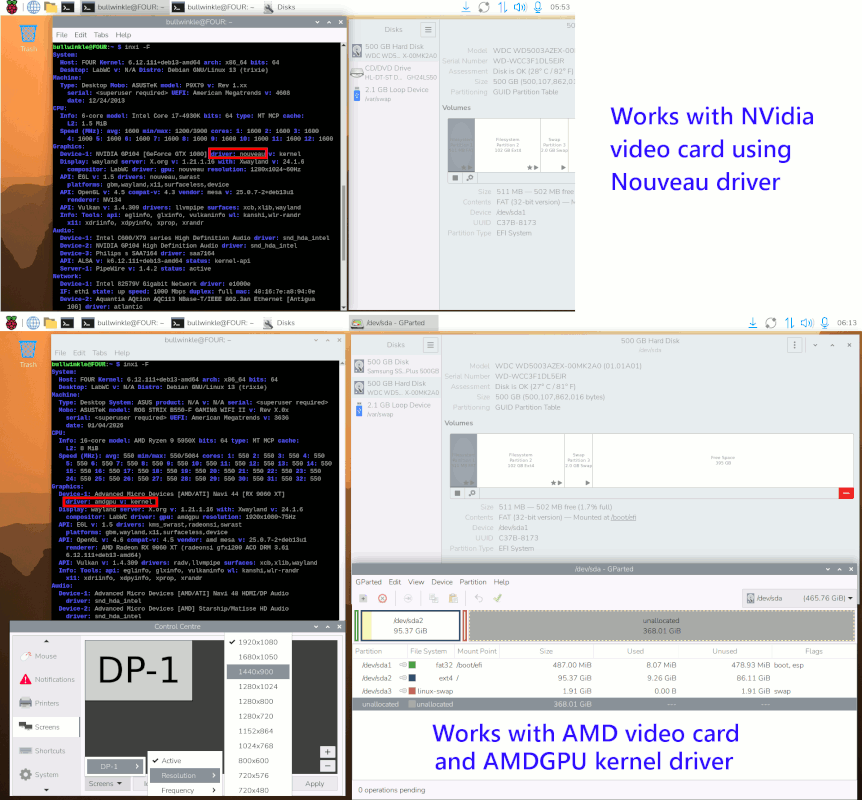
I generally use the 64-bit ones.
https://downloads.raspberrypi.com/rpd_x86/images/rpd_x86-2026-10-15/2026-10-13-raspios-trixie-amd64.iso
as it worked with both the Nvidia machine and the AMD machine
on video cards.
R.Wieser wrote:
I got an old Acer Aspire TC-780 (Win10), and, as I already got some
RPi's, I thought of putting "Raspberry Pi Desktop" on it
You've got a PC that didn't cost you a penny, with not a single byte of
data on it that you care about, you're over-thinking things ... JFDI.
Try an install with all defaults.
Apparently, asking it multiple times doesn’t change the answers, instead
it gets people’s backs up.
The specs mention an on-board video-card :
Discrete graphics card model NVIDIA® GeForce® GT 730
On-board graphics card model Intel® HD Graphics 630
I'm not at all sure what the difference between a "Discrete graphics card" and an "On-board graphics card" is though.
Thanks. The above certainly are, I think, a few gotya's to recon with.
Regards,
Rudy Wieser
Apparently, asking it multiple times doesn't change the answers,
instead it gets people's backs up.
What answers ? :-(
Imagine how frustrating it was to me having asked a question and not
getting any response to it. Not even when I clearly indicated I
wanted one.
On Sun, 11/22/2026 12:05 PM, R.Wieser wrote:
The specs mention an on-board video-card :
Discrete graphics card model NVIDIA® GeForce® GT 730
On-board graphics card model Intel® HD Graphics 630
I'm not at all sure what the difference between a "Discrete graphics card" >> and an "On-board graphics card" is though.
Thanks. The above certainly are, I think, a few gotya's to recon with.
Regards,
Rudy Wieser
The HD630 is inside the Intel CPU, and there are some interface
circuits (for making a "standard" output) inside the PCH chipset.
The GT 730 is a separate chip.
The software for running two GPUs hooked together in this
particular (and peculiar) way, is here. On Linux, it is
called "Bumblebee".
https://en.wikipedia.org/wiki/Nvidia_Optimus
"A project called Bumblebee[4] is an alternative open source
implementation of Optimus support for Linux.[5]"
The GT 730 is "high power" and runs down the battery when engaged.
It is typically switched in when playing a 3D game. For regular
mostly-2D desktop display duties, the Intel HD630 can do that,
and the GT 730 stands down. The NVidia chip does not drive
the display directly. It deposits double-buffered frames
into system memory. The Intel chip then reads out the frame
buffer from system memory (whether it is written by system
software or written by the NVidia chip). By coordinating the two chips through system memory, that means there are no tricky
switching circuits near the video output high speed
signals.
Years ago, we used to chain GPUs together via "overlay" of the
output video signal, one video output on top of the other.
One of the managers at work (I suspect more as a joke than
anything) was encouraging us to do overlays like that
in our hardware. The method used today keeps what is
going on "rather private", making it harder to hack into.
What is used today is *not* the overlay method. I have a
Mac computer here, a Voodoo card, and those were wired with
external cabling to make overlays for gaming. What's in
your computer, doesn't rely on external cables between
the Intel GPU and the NVidia one.
The above description isn't going to help you much, and
you really need the block diagram showing the wiring and
so on, to make better sense of how this works.
Anyway, if you want to keep annoying people (or at least, some people),
keep on doing what you’re doing. Up to you.
He's not overthinking but trolling. It's how every thread started
by Rudy goes.
...The specs mention an on-board video-card :
Discrete graphics card model NVIDIA® GeForce® GT 730
On-board graphics card model Intel® HD Graphics 630
The HD630 is inside the Intel CPU, and there are some interface...
circuits (for making a "standard" output) inside the PCH chipset.
The GT 730 is a separate chip.
The GT 730 is "high power" and runs down the battery when engaged.
It is typically switched in when playing a 3D game. For regular
mostly-2D desktop display duties, the Intel HD630 can do that,
and the GT 730 stands down.
Years ago, we used to chain GPUs together via "overlay" of the
output video signal, one video output on top of the other.
The above description isn't going to help you much, and
you really need the block diagram showing the wiring and
so on, to make better sense of how this works.
What do you expect, twenty people responding "I don't know"?
If someone isn't answering a question on Usenet, it is usually
because they don't know the answer.
Anyway, if you want to keep annoying people (or at least, some people),
keep on doing what you're doing. Up to you.
I should also point out the differences between laptop setups
and desktop mini-tower computers which have a standalone video card
when they were sold. The driver situation, the quirks, are different.
Desktop (Separate video subsystems, separate drivers, not a Bumblebee)
The user chooses which output to use, when they want.
when the vid card fails, the user can plug to the iGPU instead.
frameBuffers
\
CPU System
+--iGPU ----memory
|
+--PCH
|
<-Vid--+
Out <--- I/O Plate connectors of Desktop tower computer
VRAM
|
Desktop
NVidia (PCIe)
|
<-Vid-+
Out <--- Video card slot connectors
Richard,
What do you expect, twenty people responding "I don't know"?
Something like that, yes. Maybe a less-laden "I'm not aware of anything".
I don't think thats too much to ask when someone thinks they should posts something.
Anyway, if you want to keep annoying people (or at least, some
people), keep on doing what you're doing. Up to you.
I might change my approach : if someone post something that doesn't
address the question I posted I might just ignore them.
Well that is not the behavior we usually see in many-to-many
communication forums. Your expectation is just not based in reality.
I might change my approach : if someone post something that doesn't
address the question I posted I might just ignore them.
Yes, that is the sensible thing to do.
The 'puter does have two HDMI outputs, but when I checked both seemed to output the same video-signal (displaying the desktop). Though the 'puters specs say nothing about it*, they /might/ be connected to each video-card.
I will probably check and try to play around with it later.
* though it neither made clear that the "HDD+SSD" are two different devices ...
Regards,
Rudy Wieser
mm0fmf,
He's not overthinking but trolling. It's how every thread started
by Rudy goes.
I've asked you to support your claim. You refuse, and instead re-iterate your claim.
You know what that means, right ? Yes, indeed.
Plonk.
Regards,
Rudy Wieser
This isn’t a premium support line where you’re contacting Linux Incorporated and talking to someone who is either well-informed or paidAmen
to research your questions, it’s just random people with an interest in Linux and/or Raspberry Pis (depending which group they’re reading in).
On 23/11/2026 07:09, R.Wieser wrote:
mm0fmf,Odd. That seems to be your modus operandi, not his.
He's not overthinking but trolling. It's how every thread started
by Rudy goes.
I've asked you to support your claim. You refuse, and instead re-
iterate
your claim.
You know what that means, right ? Yes, indeed.LOL
Plonk.
Do you think he cares?
Regards,
Rudy Wieser
On 23/11/2026 11:50, The Natural Philosopher wrote:
On 23/11/2026 07:09, R.Wieser wrote:If he's plonked me I can refer to him as the troubling-making, trolling bullshit merchant that he is and he wont see it.
mm0fmf,Odd. That seems to be your modus operandi, not his.
He's not overthinking but trolling. It's how every thread started
by Rudy goes.
I've asked you to support your claim. You refuse, and instead re- >>> iterate
your claim.
You know what that means, right ? Yes, indeed.LOL
Plonk.
Do you think he cares?
Regards,
Rudy Wieser
However, wiring him and Paul (the bot) together will produce reams of meaningless drivel and trolling. Paul's output is known to be full of technical info that is seldom pertinent to the subject in hand and feeds Rudy's pish questioning perfectly. c.f. Graphic cards running down
batteries quickly in laptops and Rudy's wonderfully authentic troll
about does the graphics card flatten the CMOS battery. Why it would
under Linux and not Windows isn't broached as that spoils the trolling.
It's also known by many that Paul is an experimental ML-bot from a
leading East Coast US university as nobody could really rattle off so
much useless drivel in response to a question that barely touches the subject in hand.
If you leave parts unpartitioned but still containing data from
the last time it was used, the SSD is still contractually obliged
to keep the data in case you need it another time
That doesn't make any sense. The data in blocks not part of any partition (or file!) needs to be kept ? For what reason ?
but also zeroing the SSD and then leaving 10% (or whatever)
unpartitioned works too.
Again, I do not understand. The blocks in the unpartitioned area might be zeroed out, but the moment the wear-leveling mechanism swaps such a block out with one inside a partition that swapped-out block now in the unpartitioned area is going to contain data.
This one has a VGA and a HDMI on the I/O Plate area.
It has no video card, and there are four slot covers
over the four slots.
View of the inside of the machine.
Perhaps the black plastic thing is a latch controlling the side cover ?
Something seems to be askew with the PCI Express slots - only two PCIe
slots are visible and a good video card inserted in the long slot, will prevent
the second slot from being used.
The bottom area, I'm unfamiliar with that pattern, I don't think
that is a HDD bay.
# The advert
It's kinda weird, as desktops-on-a-curb go :-) Take the side off and
see if yours has more internal gubbins than that one, as I don't even
see the HDD in that internal view of the case.
The machine looks like it's been stripped of goodies.
In that picture, you can see it has one DIMM.
If it relied upon the iGPU for video, you'd likely want two DIMMs to slightly
increase memory bandwidth to feed it. Apparently, if a machine is modern enough, the iGPU is fine even with one DIMM (of high speed memory).
If you leave parts unpartitioned but still containing data from
the last time it was used, the SSD is still contractually obliged
to keep the data in case you need it another time
That doesn't make any sense. The data in blocks not part of any
partition (or file!) needs to be kept ? For what reason ?
It's complicated.
It also keeps a record of which blocks contain data and which do not.
[The situation is further complicated by the fact that the logical and physical blocks are different sizes, and that physical blocks may not
be erasable individually -- but I'm ignoring that for simplicity.]
A block contains data if it has ever been written to, unless it
has since been identified as unused using the TRIM command.
The controller doesn't know anything about filesystems or partitioning.
So, it's not that there is any reason to keep the data in those blocks,
just that there is no way to tell that there is no reason.
Again, I do not understand. The blocks in the unpartitioned area might
be zeroed out, but the moment the wear-leveling mechanism swaps such a
block out with one inside a partition that swapped-out block now in the
unpartitioned area is going to contain data.
When a block is written the controller will select the least-used
free block available,
A couple of days back I wrote that I confused myself by going with the
notion that what the OS puts on the disk (partitions or other) has got a connection with the wear-leveling the SSD does. The moment I realized that that isn't the case the whole story got rather simple.
data: api.nasa.gov (APOD, NeoWs)
| Sysop: | cequra |
|---|---|
| Location: | Grimsby United Kingdom |
| Users: | 4 |
| Nodes: | 4 (0 / 4) |
| Uptime: | 498853:01:47 |
| Calls: | 197 |
| Files: | 8,821 |
| D/L today: |
29 files (9,432K bytes) |
| Messages: | 39,038 |