• Blind fastener

    From Don Y@blockedofcourse@foo.invalid to sci.electronics.design on Wed Nov 25 17:05:51 2026
    From Newsgroup: sci.electronics.design

    I need a removable blind fastener to mount a small box to a wall plate.
    The fasteners will be hiding BEHIND the box and the plate can't be
    removed while the box is in place so the fasteners need to be blind.

    Box only weighs a pound or two but it needs to be held securely
    (several pounds removal force).

    Can't slide up, down, left, right or rotate so it must be a "press
    on, pull off" sort of fastener. Difficult to get behind it to PRY
    it off, etc.

    Has to be durable -- 10-30 year service life. (No velcro with
    dubious adhesives)

    All I could think of was ball studs. But, the receivers are
    disproportionately larger than the studs themselves. This
    complicates the mounting of the receiver to the interior of
    the plate -- both cosmetically and in terms of mechanical
    interference (need a larger "keep out" volume set aside on
    the inside of the box vs. something like a PEM nut)
    --- Synchronet 3.21e-Linux NewsLink 1.2
  • From Lumberdog@pup@play.dot to sci.electronics.design on Wed Nov 25 19:49:58 2026
    From Newsgroup: sci.electronics.design

    On 11/25/26 16:05, Don Y wrote:
    I need a removable blind fastener to mount a small box to a wall
    plate. The fasteners will be hiding BEHIND the box and the plate
    can't be removed while the box is in place so the fasteners need to
    be blind.

    Box only weighs a pound or two but it needs to be held securely (several pounds removal force).

    Can't slide up, down, left, right or rotate so it must be a "press on,
    pull off" sort of fastener. Difficult to get behind it to PRY it
    off, etc.

    Has to be durable -- 10-30 year service life. (No velcro with dubious adhesives)

    All I could think of was ball studs. But, the receivers are disproportionately larger than the studs themselves. This complicates
    the mounting of the receiver to the interior of the plate -- both cosmetically and in terms of mechanical interference (need a larger
    "keep out" volume set aside on the inside of the box vs. something
    like a PEM nut)

    I'm thinking
    "spring clips that hold the bathroom ceiling fan grille/cover"

    https://www.homedepot.com/p/PBTEK-Stainless-Steel-Bathroom-Fan-Grille-Spring-Clips-3-Pack-Replacement-for-Vent-Fan-Covers-Secure-Fit-6-8-7P5CXE9T/700410785

    https://www.lowes.com/pd/Misopily-10-Pack-Stainless-Steel-Spring-Clips-for-Recessed-Lighting-Trims-and-Bathroom-Ceiling-Exhaust-Fan-Light-Cover-Replacement/105834471

    Get some springy wire and bend your own.
    --- Synchronet 3.21e-Linux NewsLink 1.2
  • From liz@liz@poppyrecords.invalid.invalid (Liz Tuddenham) to sci.electronics.design on Thu Nov 26 09:43:51 2026
    From Newsgroup: sci.electronics.design

    Don Y <blockedofcourse@foo.invalid> wrote:

    I need a removable blind fastener to mount a small box to a wall plate.
    The fasteners will be hiding BEHIND the box and the plate can't be
    removed while the box is in place so the fasteners need to be blind.

    Box only weighs a pound or two but it needs to be held securely
    (several pounds removal force).

    Can't slide up, down, left, right or rotate so it must be a "press
    on, pull off" sort of fastener. Difficult to get behind it to PRY
    it off, etc.

    Has to be durable -- 10-30 year service life. (No velcro with
    dubious adhesives)

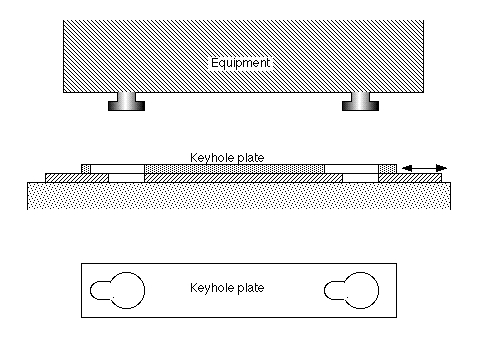
    Two keyhole slots in a sliding plate on the back plate, engaging with
    'inverted top hat' studs on the equipment. The keyhole plate could be
    pushed sideways with a flat-bladed screwdriver to engage and disengage.

    http://www.poppyrecords.co.uk/other/Latch.gif
    --
    ~ Liz Tuddenham ~
    (Remove the ".invalid"s and add ".co.uk" to reply)
    www.poppyrecords.co.uk
    --- Synchronet 3.21e-Linux NewsLink 1.2
  • From Lasse Langwadt@llc@fonz.dk to sci.electronics.design on Thu Nov 26 17:50:45 2026
    From Newsgroup: sci.electronics.design

    On 11/26/26 10:43, Liz Tuddenham wrote:
    Don Y <blockedofcourse@foo.invalid> wrote:

    I need a removable blind fastener to mount a small box to a wall plate.
    The fasteners will be hiding BEHIND the box and the plate can't be
    removed while the box is in place so the fasteners need to be blind.

    Box only weighs a pound or two but it needs to be held securely
    (several pounds removal force).

    Can't slide up, down, left, right or rotate so it must be a "press
    on, pull off" sort of fastener. Difficult to get behind it to PRY
    it off, etc.

    Has to be durable -- 10-30 year service life. (No velcro with
    dubious adhesives)

    Two keyhole slots in a sliding plate on the back plate, engaging with 'inverted top hat' studs on the equipment. The keyhole plate could be
    pushed sideways with a flat-bladed screwdriver to engage and disengage.

    http://www.poppyrecords.co.uk/other/Latch.gif


    sorta similar to din rail boxes, https://upload.wikimedia.org/wikipedia/commons/6/6f/DIN_rail_rear_view.JPG
    --- Synchronet 3.21e-Linux NewsLink 1.2
  • From Jeff Layman@Jeff@invalid.invalid to sci.electronics.design on Thu Nov 26 17:34:04 2026
    From Newsgroup: sci.electronics.design

    On 26/11/2026 00:05, Don Y wrote:
    I need a removable blind fastener to mount a small box to a wall plate.
    The fasteners will be hiding BEHIND the box and the plate can't be
    removed while the box is in place so the fasteners need to be blind.

    Box only weighs a pound or two but it needs to be held securely
    (several pounds removal force).

    Can't slide up, down, left, right or rotate so it must be a "press
    on, pull off" sort of fastener. Difficult to get behind it to PRY
    it off, etc.

    Has to be durable -- 10-30 year service life. (No velcro with
    dubious adhesives)

    All I could think of was ball studs. But, the receivers are disproportionately larger than the studs themselves. This
    complicates the mounting of the receiver to the interior of
    the plate -- both cosmetically and in terms of mechanical
    interference (need a larger "keep out" volume set aside on
    the inside of the box vs. something like a PEM nut)

    What are the wall plate and box made of? Would it be possible to put a
    thin sheet of mild steel inside the box and perhaps stick or glue a
    similar mild steel sheet to the wall plate? Then use thin N42 neodymium magnets to hold the box to the plate. For example, each of these 15 x
    1mm magnets have a hold force of 1.1kg: <https://www.first4magnets.com/product/15mm-dia-x-1mm-thick-n42-neodymium-magnet-11kg-pull-19306>
    If you used all of them from a 20-pack, it would require a force
    exceeding 40lb to remove the box from the plate.
    --
    Jeff
    --- Synchronet 3.21e-Linux NewsLink 1.2
  • From Don Y@blockedofcourse@foo.invalid to sci.electronics.design on Thu Nov 26 13:13:19 2026
    From Newsgroup: sci.electronics.design

    On 11/26/2026 2:43 AM, Liz Tuddenham wrote:
    Don Y <blockedofcourse@foo.invalid> wrote:

    I need a removable blind fastener to mount a small box to a wall plate.
    The fasteners will be hiding BEHIND the box and the plate can't be
    removed while the box is in place so the fasteners need to be blind.

    Box only weighs a pound or two but it needs to be held securely
    (several pounds removal force).

    Can't slide up, down, left, right or rotate so it must be a "press
    on, pull off" sort of fastener. Difficult to get behind it to PRY
    it off, etc.

    Has to be durable -- 10-30 year service life. (No velcro with
    dubious adhesives)

    Two keyhole slots in a sliding plate on the back plate, engaging with 'inverted top hat' studs on the equipment. The keyhole plate could be
    pushed sideways with a flat-bladed screwdriver to engage and disengage.

    http://www.poppyrecords.co.uk/other/Latch.gif
    That could work. I'd have to add some "bias" to the slots so they pulled
    the box tight to the wall as they secured it (I don't want the boxes to
    flop around/rattle in place as that will invite added attention)
    --- Synchronet 3.21e-Linux NewsLink 1.2
  • From Don Y@blockedofcourse@foo.invalid to sci.electronics.design on Thu Nov 26 13:33:39 2026
    From Newsgroup: sci.electronics.design

    On 11/26/2026 10:34 AM, Jeff Layman wrote:
    On 26/11/2026 00:05, Don Y wrote:
    I need a removable blind fastener to mount a small box to a wall plate.
    The fasteners will be hiding BEHIND the box and the plate can't be
    removed while the box is in place so the fasteners need to be blind.

    Box only weighs a pound or two but it needs to be held securely
    (several pounds removal force).

    Can't slide up, down, left, right or rotate so it must be a "press
    on, pull off" sort of fastener.  Difficult to get behind it to PRY
    it off, etc.

    Has to be durable -- 10-30 year service life.  (No velcro with
    dubious adhesives)

    All I could think of was ball studs.  But, the receivers are
    disproportionately larger than the studs themselves.  This
    complicates the mounting of the receiver to the interior of
    the plate -- both cosmetically and in terms of mechanical
    interference (need a larger "keep out" volume set aside on
    the inside of the box vs. something like a PEM nut)

    What are the wall plate and box made of?

    Wall plates are made of stainless (eventually, the "boxes" will
    reside *behind* the plates; I just want to shortcut a design step
    for the time being figureing anything I do to the wall plates can
    be easily undone -- by replacing them!)

    Boxes tend to be plastic (in the interim, I am mounting COTS
    devices so I have little control over their fabrication)

    Would it be possible to put a thin
    sheet of mild steel inside the box and perhaps stick or glue a similar mild steel sheet to the wall plate? Then use thin N42 neodymium magnets to hold the

    I could probably find a way of securing "something" to the underside of the box) and something similar to the wall plate.

    And, could arrange some sort of "guides" to ensure the magnets cause the
    boxes to fit in their desired locations (I have several of these boxes
    and they should look like they are sited in specific locations, not willy-nilly)

    box to the plate. For example, each of these 15 x 1mm magnets have a hold force
    of 1.1kg: <https://www.first4magnets.com/product/15mm-dia-x-1mm-thick-n42-neodymium- magnet-11kg-pull-19306>
    If you used all of them from a 20-pack, it would require a force exceeding 40lb
    to remove the box from the plate.

    In general, I dislike magnets -- because they "attract" other unintended things and need to be "cleaned" prior to use, lest some of that cruft get caught behind it.

    But, maybe I can use the *plate* with the ball stud receivers and hide
    it *behind* the wall plate -- fasten the receivers to the back side of the plate (which need not have any cosmetic value) and just drill holes
    through the wall plate for the balls to mate with the receivers. So,
    when the box is NOT mounted, there is just a clean hole.

    Or, put that plate on the back of the box with the studs protruding from the wall plate (but that means the plate adds some thickness and unwanted distance between box and wall plate as the receivers would have to be exist in that
    gap)

    Grrr... all this mechanical/packaging crap is a pain in the ass.

    --- Synchronet 3.21e-Linux NewsLink 1.2
  • From liz@liz@poppyrecords.invalid.invalid (Liz Tuddenham) to sci.electronics.design on Thu Nov 26 23:35:03 2026
    From Newsgroup: sci.electronics.design

    Don Y <blockedofcourse@foo.invalid> wrote:

    On 11/26/2026 2:43 AM, Liz Tuddenham wrote:
    Don Y <blockedofcourse@foo.invalid> wrote:

    I need a removable blind fastener to mount a small box to a wall plate.
    The fasteners will be hiding BEHIND the box and the plate can't be
    removed while the box is in place so the fasteners need to be blind.

    Box only weighs a pound or two but it needs to be held securely
    (several pounds removal force).

    Can't slide up, down, left, right or rotate so it must be a "press
    on, pull off" sort of fastener. Difficult to get behind it to PRY
    it off, etc.

    Has to be durable -- 10-30 year service life. (No velcro with
    dubious adhesives)

    Two keyhole slots in a sliding plate on the back plate, engaging with 'inverted top hat' studs on the equipment. The keyhole plate could be pushed sideways with a flat-bladed screwdriver to engage and disengage.

    http://www.poppyrecords.co.uk/other/Latch.gif
    That could work. I'd have to add some "bias" to the slots so they pulled
    the box tight to the wall as they secured it (I don't want the boxes to
    flop around/rattle in place as that will invite added attention)

    You could add a bistable spring toggle mechanism that held the latch
    plate in one of two positions or you could push the box down against a
    leaf spring while you slid the plate and arrange that the box locked the
    plate as it sprung back.
    --
    ~ Liz Tuddenham ~
    (Remove the ".invalid"s and add ".co.uk" to reply)
    www.poppyrecords.co.uk
    --- Synchronet 3.21e-Linux NewsLink 1.2
  • From Don Y@blockedofcourse@foo.invalid to sci.electronics.design on Thu Nov 26 21:16:38 2026
    From Newsgroup: sci.electronics.design

    On 11/26/2026 4:35 PM, Liz Tuddenham wrote:
    Don Y <blockedofcourse@foo.invalid> wrote:

    On 11/26/2026 2:43 AM, Liz Tuddenham wrote:
    Don Y <blockedofcourse@foo.invalid> wrote:

    I need a removable blind fastener to mount a small box to a wall plate. >>>> The fasteners will be hiding BEHIND the box and the plate can't be
    removed while the box is in place so the fasteners need to be blind.

    Box only weighs a pound or two but it needs to be held securely
    (several pounds removal force).

    Can't slide up, down, left, right or rotate so it must be a "press
    on, pull off" sort of fastener. Difficult to get behind it to PRY
    it off, etc.

    Has to be durable -- 10-30 year service life. (No velcro with
    dubious adhesives)

    Two keyhole slots in a sliding plate on the back plate, engaging with
    'inverted top hat' studs on the equipment. The keyhole plate could be
    pushed sideways with a flat-bladed screwdriver to engage and disengage.

    http://www.poppyrecords.co.uk/other/Latch.gif
    That could work. I'd have to add some "bias" to the slots so they pulled
    the box tight to the wall as they secured it (I don't want the boxes to
    flop around/rattle in place as that will invite added attention)

    You could add a bistable spring toggle mechanism that held the latch
    plate in one of two positions or you could push the box down against a
    leaf spring while you slid the plate and arrange that the box locked the plate as it sprung back.
    <grin> *You* might be able to do those things but my metalworking
    skills and tools are limited to filing and drilling holes!

    (But, I'm pretty good shaping wood and have amused clients with
    very elaborate *wooden* prototypes in the past!)

    I only need a temporary fix as, eventually, the "boxes" will reside
    *behind* the wall plates (but, COTS boxes are physically too large
    and draw too much power so I need to fasten them "outboard" for the
    time being; the effort to design equivalent devices is significant!).

    If it was just for a "one off", I would resort to velcro. But, when
    folks see these things, I need them to see a production approach to
    the problems, not a prototype hack. (and the only thing more hackish
    than velcro is duct tape!)

    --- Synchronet 3.21e-Linux NewsLink 1.2
  • From liz@liz@poppyrecords.invalid.invalid (Liz Tuddenham) to sci.electronics.design on Fri Nov 27 08:48:09 2026
    From Newsgroup: sci.electronics.design

    Don Y <blockedofcourse@foo.invalid> wrote:

    On 11/26/2026 4:35 PM, Liz Tuddenham wrote:
    Don Y <blockedofcourse@foo.invalid> wrote:

    On 11/26/2026 2:43 AM, Liz Tuddenham wrote:
    Don Y <blockedofcourse@foo.invalid> wrote:

    I need a removable blind fastener to mount a small box to a wall plate. >>>> The fasteners will be hiding BEHIND the box and the plate can't be
    removed while the box is in place so the fasteners need to be blind. >>>>
    Box only weighs a pound or two but it needs to be held securely
    (several pounds removal force).

    Can't slide up, down, left, right or rotate so it must be a "press
    on, pull off" sort of fastener. Difficult to get behind it to PRY
    it off, etc.

    Has to be durable -- 10-30 year service life. (No velcro with
    dubious adhesives)

    Two keyhole slots in a sliding plate on the back plate, engaging with
    'inverted top hat' studs on the equipment. The keyhole plate could be >>> pushed sideways with a flat-bladed screwdriver to engage and disengage. >>>
    http://www.poppyrecords.co.uk/other/Latch.gif
    That could work. I'd have to add some "bias" to the slots so they pulled >> the box tight to the wall as they secured it (I don't want the boxes to
    flop around/rattle in place as that will invite added attention)

    You could add a bistable spring toggle mechanism that held the latch
    plate in one of two positions or you could push the box down against a
    leaf spring while you slid the plate and arrange that the box locked the plate as it sprung back.
    <grin> *You* might be able to do those things but my metalworking
    skills and tools are limited to filing and drilling holes!

    You could make most of that with hand tools; if you haven't got access
    to a lathe, the 'top hats' could be made from a bolt with a stack of
    different sized washers. Springs can be made from piano wire if you
    don't have a grinder to shape leaf springs - or an elastic band may be sufficient if you just want temporary proof-of-concept.


    (But, I'm pretty good shaping wood and have amused clients with
    very elaborate *wooden* prototypes in the past!)

    I only need a temporary fix as, eventually, the "boxes" will reside
    *behind* the wall plates (but, COTS boxes are physically too large
    and draw too much power so I need to fasten them "outboard" for the
    time being; the effort to design equivalent devices is significant!).

    If it was just for a "one off", I would resort to velcro. But, when
    folks see these things, I need them to see a production approach to
    the problems, not a prototype hack. (and the only thing more hackish
    than velcro is duct tape!)

    As Lasse Langwadt suggested, could you modify a DIN rail system? I
    wouldn't be surpried if someone makes the mechanisms with empty boxes or
    panels for special apparatus.
    --
    ~ Liz Tuddenham ~
    (Remove the ".invalid"s and add ".co.uk" to reply)
    www.poppyrecords.co.uk
    --- Synchronet 3.21e-Linux NewsLink 1.2
  • From Don Y@blockedofcourse@foo.invalid to sci.electronics.design on Fri Nov 27 05:46:23 2026
    From Newsgroup: sci.electronics.design

    On 11/27/2026 1:48 AM, Liz Tuddenham wrote:
    Has to be durable -- 10-30 year service life. (No velcro with
    dubious adhesives)

    Two keyhole slots in a sliding plate on the back plate, engaging with >>>>> 'inverted top hat' studs on the equipment. The keyhole plate could be >>>>> pushed sideways with a flat-bladed screwdriver to engage and disengage. >>>>>
    http://www.poppyrecords.co.uk/other/Latch.gif
    That could work. I'd have to add some "bias" to the slots so they pulled >>>> the box tight to the wall as they secured it (I don't want the boxes to >>>> flop around/rattle in place as that will invite added attention)

    You could add a bistable spring toggle mechanism that held the latch
    plate in one of two positions or you could push the box down against a
    leaf spring while you slid the plate and arrange that the box locked the >>> plate as it sprung back.
    <grin> *You* might be able to do those things but my metalworking
    skills and tools are limited to filing and drilling holes!

    You could make most of that with hand tools; if you haven't got access
    to a lathe, the 'top hats' could be made from a bolt with a stack of different sized washers. Springs can be made from piano wire if you
    don't have a grinder to shape leaf springs - or an elastic band may be sufficient if you just want temporary proof-of-concept.

    It will look "hand made". I have striven to present a "production"
    appearance with all of the devices.

    As there are way too many to leave "exposed" (without making the
    place look like a bunch of kit EVERYWHERE), I have taken to "hiding"
    them -- in walls, above ceilings, ON ceilings, etc.

    Anything "exposed" is in a small, classy enclosure -- and *still*
    unobtrusive.

    I use 411 jboxes for the units that hide in walls, covering each with
    a ~4.5" sq cover plate made of stainless steel that provides access to
    the device (and its wiring) when needed. Everything looks really "clean"
    (and the stainless isn't as tacky as a plastic/nylon cover plate would be)

    But, some of the nodes are essentially compute servers; no I/O.
    Their computational needs tend to be greater than the I/O nodes.
    So, the "CPU module" that I've designed for the multitude of
    (I/O) nodes is a bit less than desirable, despite being overkill
    for those I/O nodes.

    Or, has an outsized impact on system performance as the node's role
    isn't I/O limited.

    For example, I have a pair of nodes (primary and backup) that implement
    the RDBMS service that acts as the persistent store -- applications
    don't parse files (there are no files) but, rather, request
    stored data/parameters: "How much precipitation was received
    between dates A and B?" "What does Bob's voice sound like?"
    "What time did Tony go to bed for the past two weeks?" "How
    do I get in touch with Cheryl?"

    I have no desire to write an RDBMS -- there are too many good
    offerings out there and too much "art" in their proper design.

    But, they run on commodity hardware and, as such, don't know
    how to take advantage of (nor coexist with) my RTOS. E.g.,
    I can't MOVE the code, while it is running, to another
    node if the need arises.

    Nor does the code expect someone to pilfer resources from it
    while it is executing so those resources can be validated as
    actually reliably operational.

    I.e., porting such an application to "my world" is a significant
    step. As is designing hardware that can best host it (with a
    limited power budget).

    Yet, this is a well-defined set of abilities that could be
    deferred to a later date: build a shim that acts as a bridge
    to allow the interface to conform to the object-based design
    that I use and hide the SQL behind an active agent and no one
    need know that the actual RDBMS isn't running on "my" hardware.

    Amusingly, NUCs are almost exactly the size of the stainless
    steel cover plates! Too large to get *into* the 411 jboxes
    (where their ultimate replacements will reside) but small
    enough to be *warts* on their skins!

    And, as their power requirements exceed the 15W available from
    the PoE drops that power the nodes, they need to be accessed by
    an external wall wart.

    Thankfully, their appearance isn't hackish (and I only need
    to connect a network cable to them -- no monitor, keyboard,
    etc.) so having a few of these bulging out of the wall can
    be easily explained away to visitors (esp as those locations
    aren't in "public spaces")

    It would be nice to be able to easily remove such a device
    to demonstrate that it is a "temporary bolt on" without
    leaving evidence of some significant "adjustment" to
    accommodate it (just a short CAT5e pigtail that disappears
    behind the stainless steel cover and connects to the
    shim located inside)

    (But, I'm pretty good shaping wood and have amused clients with
    very elaborate *wooden* prototypes in the past!)

    I only need a temporary fix as, eventually, the "boxes" will reside
    *behind* the wall plates (but, COTS boxes are physically too large
    and draw too much power so I need to fasten them "outboard" for the
    time being; the effort to design equivalent devices is significant!).

    If it was just for a "one off", I would resort to velcro. But, when
    folks see these things, I need them to see a production approach to
    the problems, not a prototype hack. (and the only thing more hackish
    than velcro is duct tape!)

    As Lasse Langwadt suggested, could you modify a DIN rail system? I
    wouldn't be surpried if someone makes the mechanisms with empty boxes or panels for special apparatus.

    The "boxes" aren't negotiable. Nor are the size constraints. I have
    to fit the attaching mechanism to whatever COTS devices I find (the NUCs
    being just one such example). Any such "warts" need to obviously be
    temporary -- by the presence of the "real" enclosure beneath/behind said box.

    --- Synchronet 3.21e-Linux NewsLink 1.2